
Planning
25 July 2026
Wedding Decor and Styling in Cyprus: How to Design a Day That Fits the Island
Five styling directions that genuinely work on this island, shown through real ceremony and reception setups — and an honest look at what Cyprus itself does to a design, from coastal wind to the golden-hour light.
Most couples come to us with a venue in mind and a rough budget in their heads, and then, somewhere in the second or third conversation, the real question arrives: what will it actually look like? Not the checklist of it — the feeling. The moment the doors open and the people they love see the room for the first time.
That is what styling is for, and it is also the part of the day guests spend the longest inside. They will glance at the ceremony flowers for twenty minutes; they will sit at that table for five hours. It is why we treat decor and styling as a design discipline rather than a shopping list, and why it runs alongside the planning itself in our Complete Wedding Planning Experience rather than being bolted on at the end.
What follows is how we think about it: five design directions that genuinely work on this island, shown through real setups, and then an honest account of what Cyprus itself does to a scheme once you take it outdoors.
What actually shapes a scheme — and it is rarely the flowers
Couples usually arrive with a colour. It is the natural place to begin, and it is almost never where we begin.
Three things come first. The setting's own character, because you are always styling on top of something that already has a voice — stone, timber and bougainvillea ask for one thing; a white contemporary terrace above the sea asks for something quite different. The light at the hour you are marrying, because a palette that looks considered at six in the evening can look thin and washed out at two in the afternoon. And the way people will physically move through the day — where they arrive, where they stand with a drink in their hand, what they see in the first second after they sit down.
Get those three right and the colour decision very nearly makes itself. Get them wrong and no quantity of flowers will rescue it. We have written before about choosing your venue without falling in love with the wrong details — this is that same argument carried one step further, into the design itself.
Classic white, and why it is harder than it looks
White is the direction couples request most often, and it is the least forgiving of them all. Take colour out of a scheme and there is nothing left to hide behind: every decision falls to texture, scale and repetition. The difference between a white wedding that looks quietly expensive and one that looks unfinished is almost never the flowers themselves. It is whether the ground florals have enough volume to read from the back row, whether the plinths are tall enough to sit above the heads of seated guests, and whether the organza on the chairs has the same weight as the linen on the tables.
It works best where the setting supplies the contrast for you. On the clifftop lawn at Alassos, the horizon does the job a colour palette would otherwise have to do — the sea sits behind the aisle as one uninterrupted block of blue, and the white reads as deliberate rather than absent. The same logic holds across most beach weddings in Cyprus: the less you have to fight the background, the less styling you need.
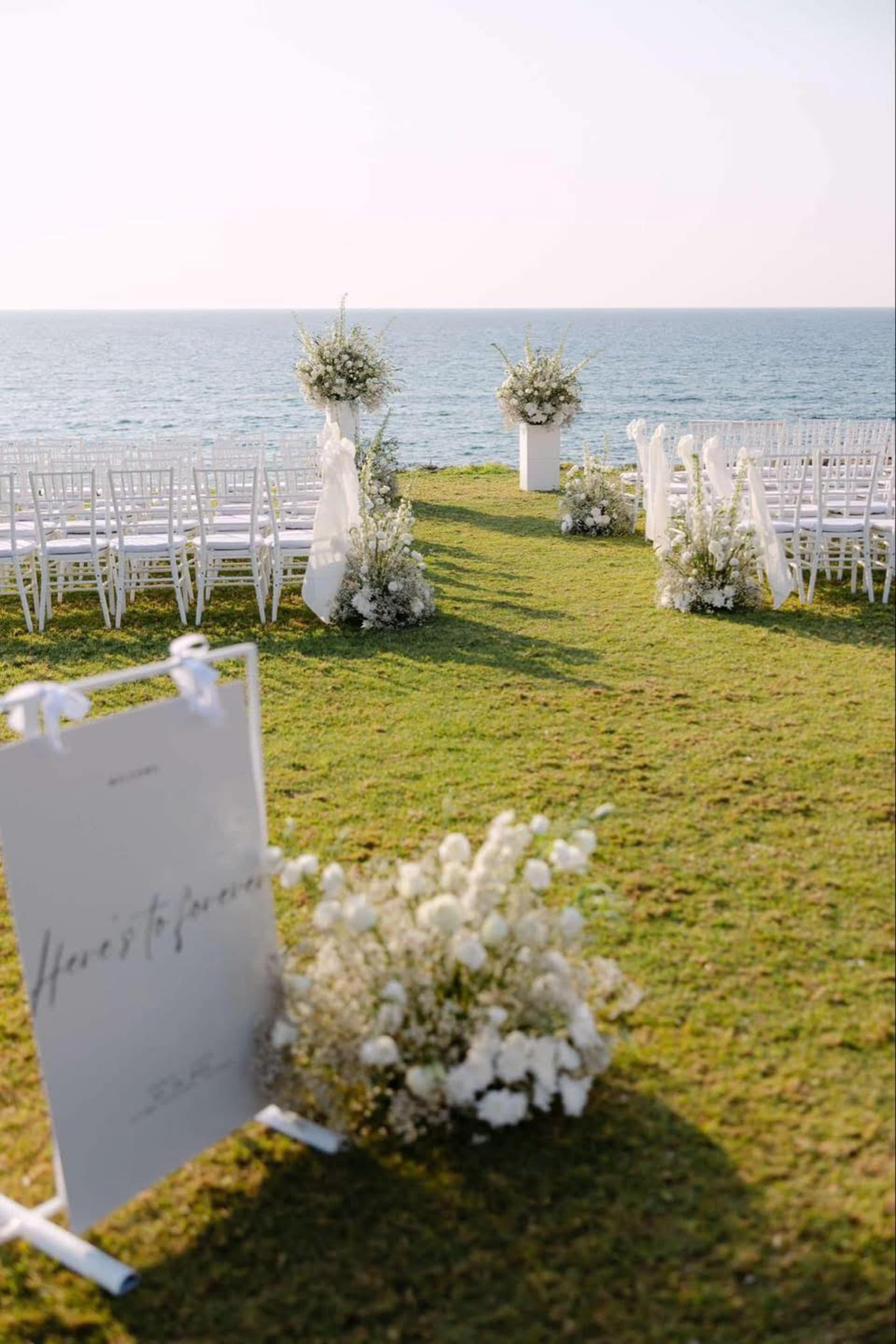
An all-white ceremony at Alassos — plinths, ground florals and organza-tied chairs, with the horizon doing the work a colour palette would otherwise have to do.
Monochrome, for couples who want something modern
A quieter trend, and one we have styled a great deal more of in the last two seasons: white, black and silver, held to a strict line. Tall rose globes on slim black stands, beaded charger plates, black napkins folded sharp, acrylic table numbers, a neon sign where a floral backdrop might otherwise go.
It reads editorial rather than romantic, which is precisely the point for some couples. It also has a practical advantage that is rarely mentioned — because the scheme is built on contrast rather than on softness, it photographs unusually well in hard midday light, when gentler palettes tend to flatten out. If you are marrying in the middle of the day rather than late in the afternoon, this direction rewards you for it.
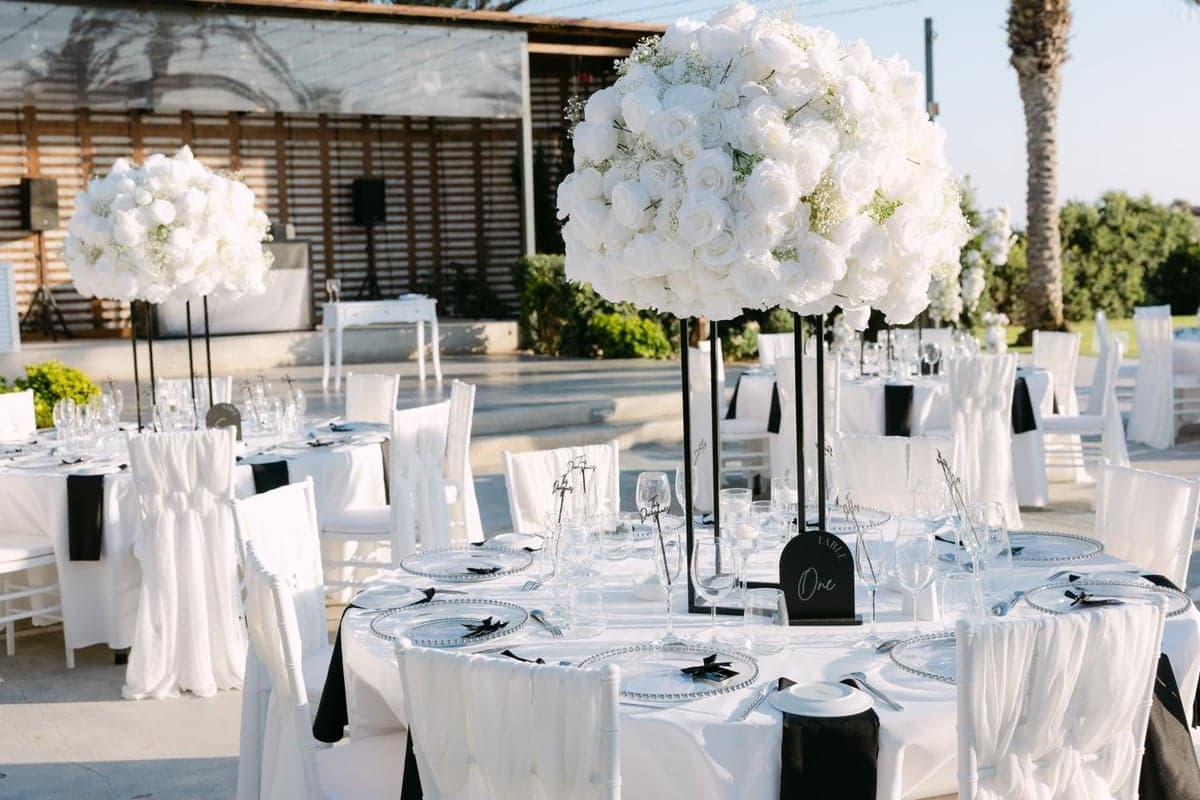
White, black and silver held to a strict line — tall rose globes lifted clear of the table, with the detail carried by the place settings rather than the flowers.
Statement colour, held in check
Bold colour is the direction couples are most nervous about, and it is usually nerves worth overcoming. The discipline is restraint: choose one dominant colour, repeat it with real conviction, and keep everything around it neutral.
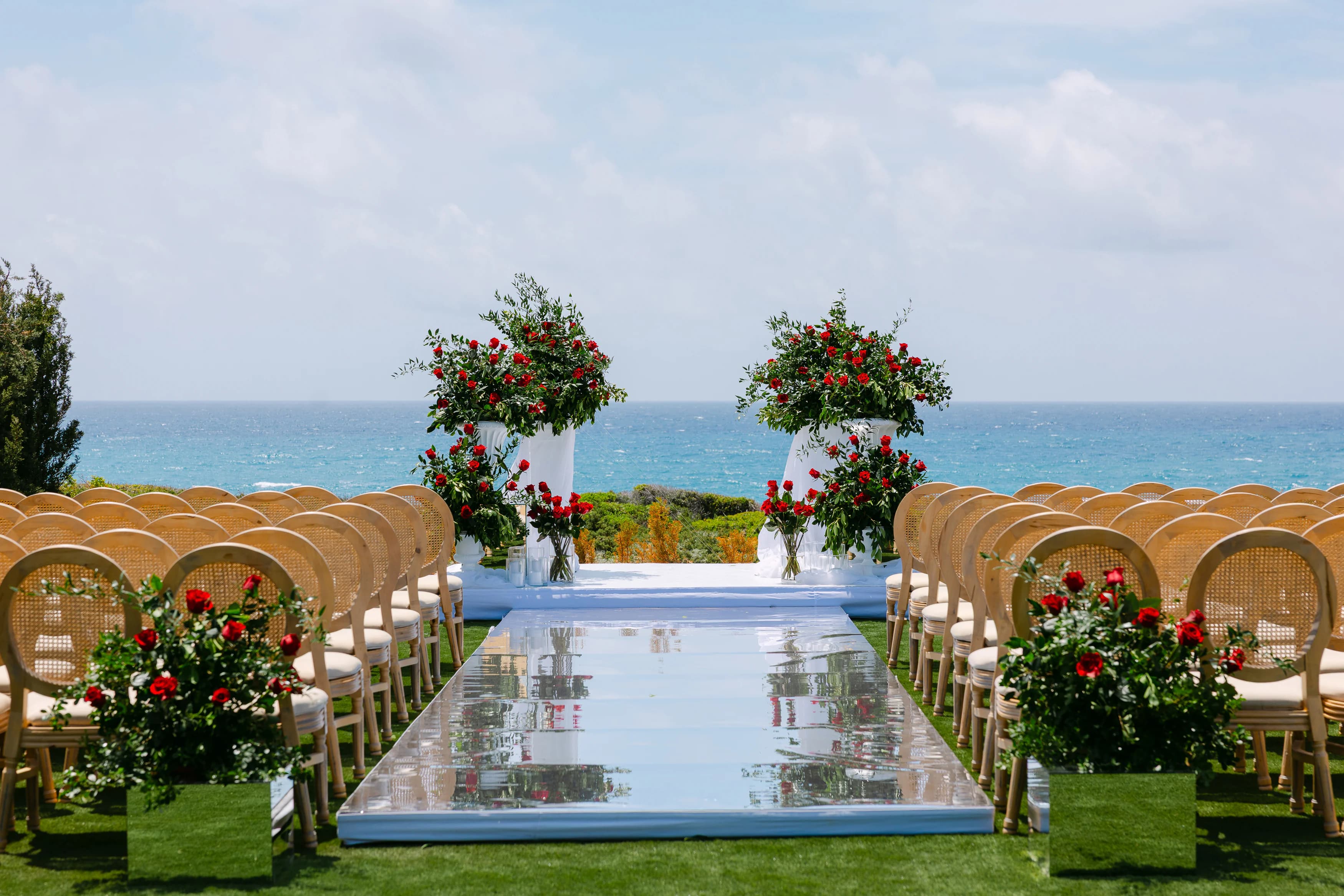
At OZEA we ran deep red through an entire day — roses on the altar plinths, single stems marking the aisle, a low run of them down the centre of every banquet table — while the furniture stayed light and quiet. Cane chairs, white tables, clear glass, gold arches. The colour has nowhere to compete, so it lands as intentional rather than loud. A mirrored aisle runner underneath it doubles the flowers and the sky at no extra cost, which is the sort of trick that only works when the rest of the scheme is disciplined enough to carry it.
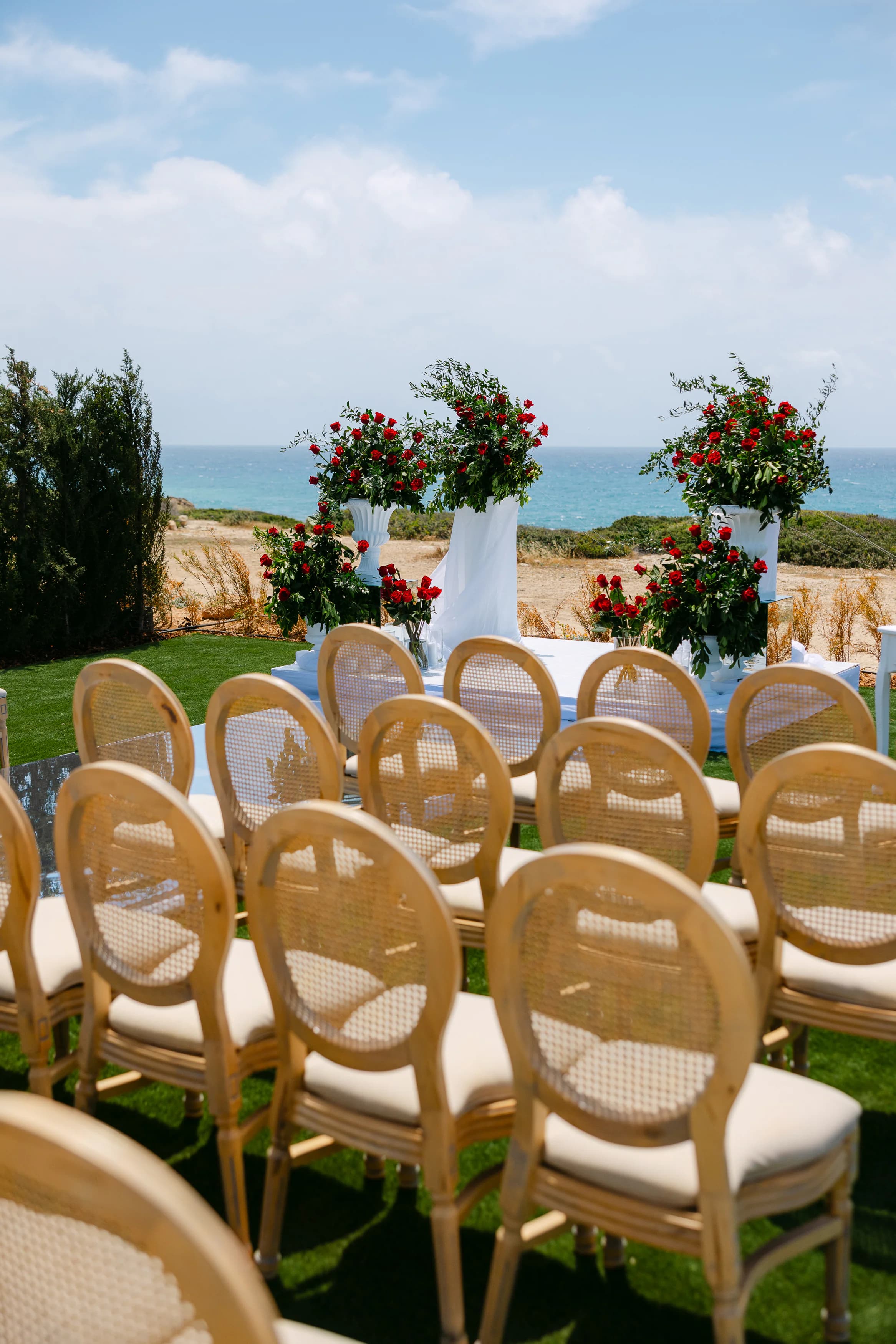
The altar at OZEA — the arrangements lifted onto plinths so the red reads clearly against the sea instead of sinking into the greenery behind it.
Rustic Mediterranean — the island's own register
If there is a styling direction Cyprus was built for, it is this one. Long timber tables, bud vases in loose repetition, blush and ivory ground florals spilling onto stone, cross-back chairs, and a festoon canopy strung overhead so the evening has somewhere to land.
It is the direction that needs the least work to feel at home, because so much of it is already present in the venues themselves — the stonework at L'Chateau, the gravel and the geraniums, the low walls. You are not importing a look so much as agreeing with the one that is already there. It suits villa weddings particularly well, where the setting is domestic in scale and a more formal scheme can feel starched against it.
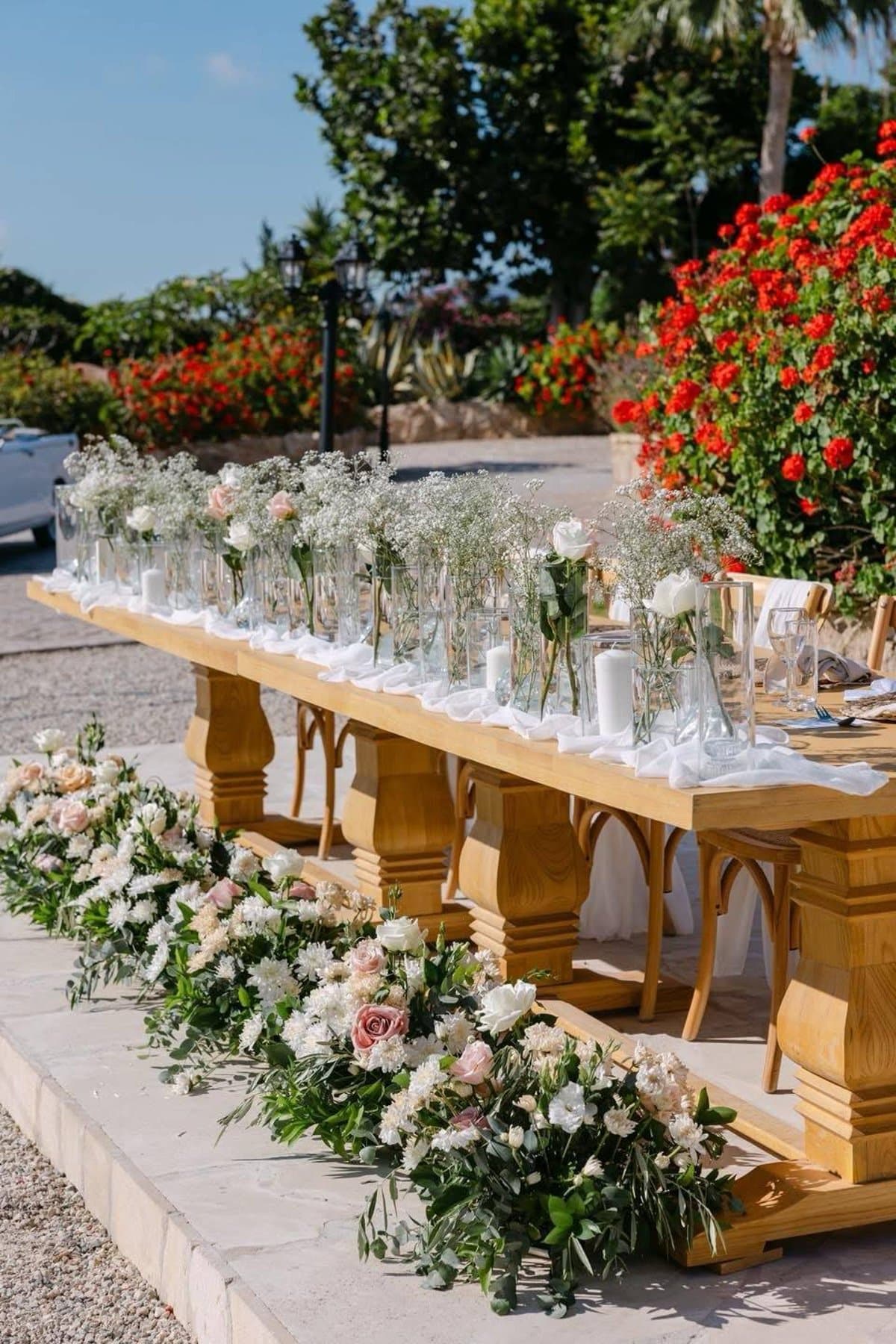
A head table at L'Chateau — bud vases in loose repetition, and ground florals allowed to spill onto the stone rather than stopping neatly at the table edge.
Boho, and the question of texture
Macramé, pampas, raw timber, warm metals, dried grasses alongside fresh stems. Boho is the direction couples most often fall for on a mood board and most often struggle to place, because it depends almost entirely on texture — and texture needs something to answer it back.
It works when the venue already has surfaces with character. Against the stonework and the timber pergola at Liopetro, a macramé backdrop and a pampas-flanked sweetheart table read as layered and considered. Set the same pieces against a flat modern wall and they can look adrift. This is the direction where the venue conversation and the styling conversation genuinely have to happen together, rather than one after the other.
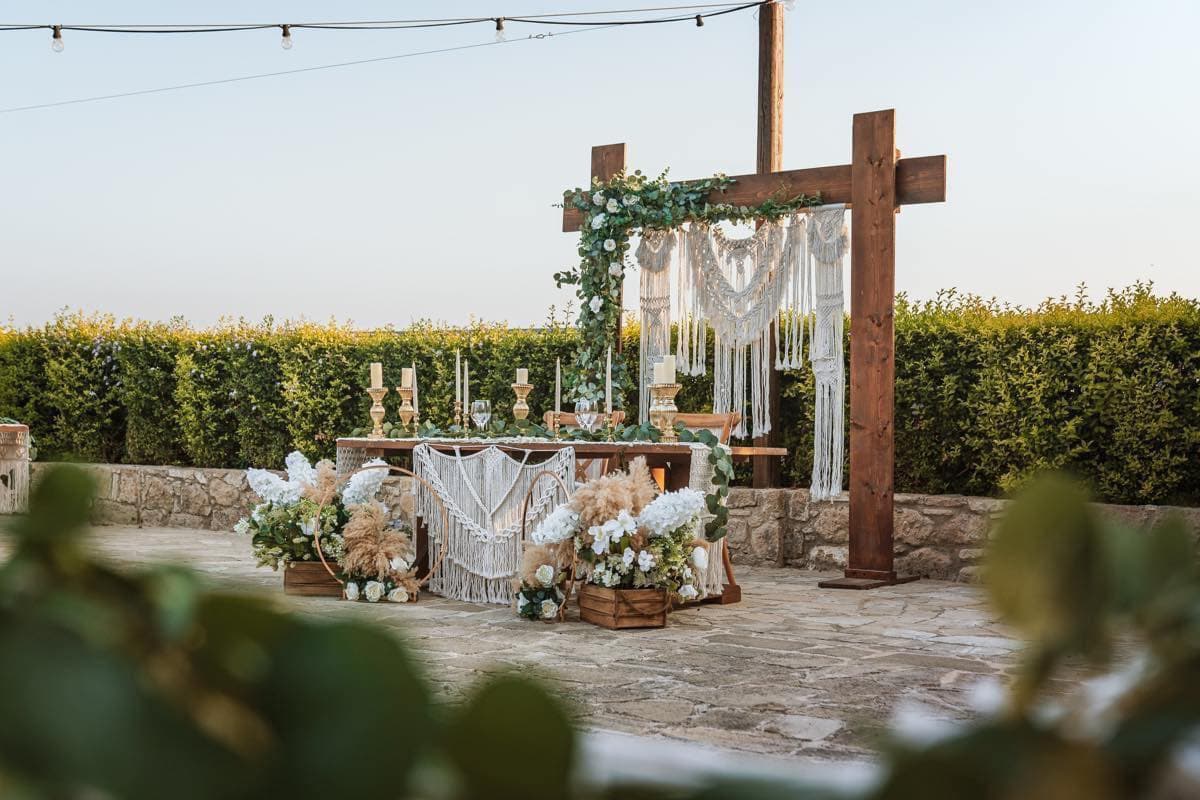
A macramé-backed sweetheart table at Liopetro — texture layered against stone and timber, which is exactly the setting this direction needs.
The details that carry the most weight
After enough weddings, you learn where the money actually shows. Not always where couples expect:
- Chair dressing. Chairs appear in every wide photograph of the day, in numbers. Changing the chair — or simply dressing the one the venue supplies — shifts the look of the entire space more than almost anything else you can do for the same spend.
- Place settings. Guests look at a table setting for hours at close range. Charger plates, napkin treatment, a folded menu, a name card in the right hand — this is the layer people actually remember touching.
- Signage. A welcome board and a seating plan are the first and second things guests read. They set the tone before anyone has seen a single flower, and they are among the easiest elements to make properly personal.
- Lighting. The single biggest transformation between the day and the evening, and the one most often left until last. Festoons, uplighters, candlelight and neon do more after sunset than any additional florals will.
The full inventory — chair dressing and linens, centrepieces, illuminated features, arches and backdrops, signage and props, statement pieces and dance floors — lives on our decor and styling page, and it is considerably larger than most couples expect before they visit.
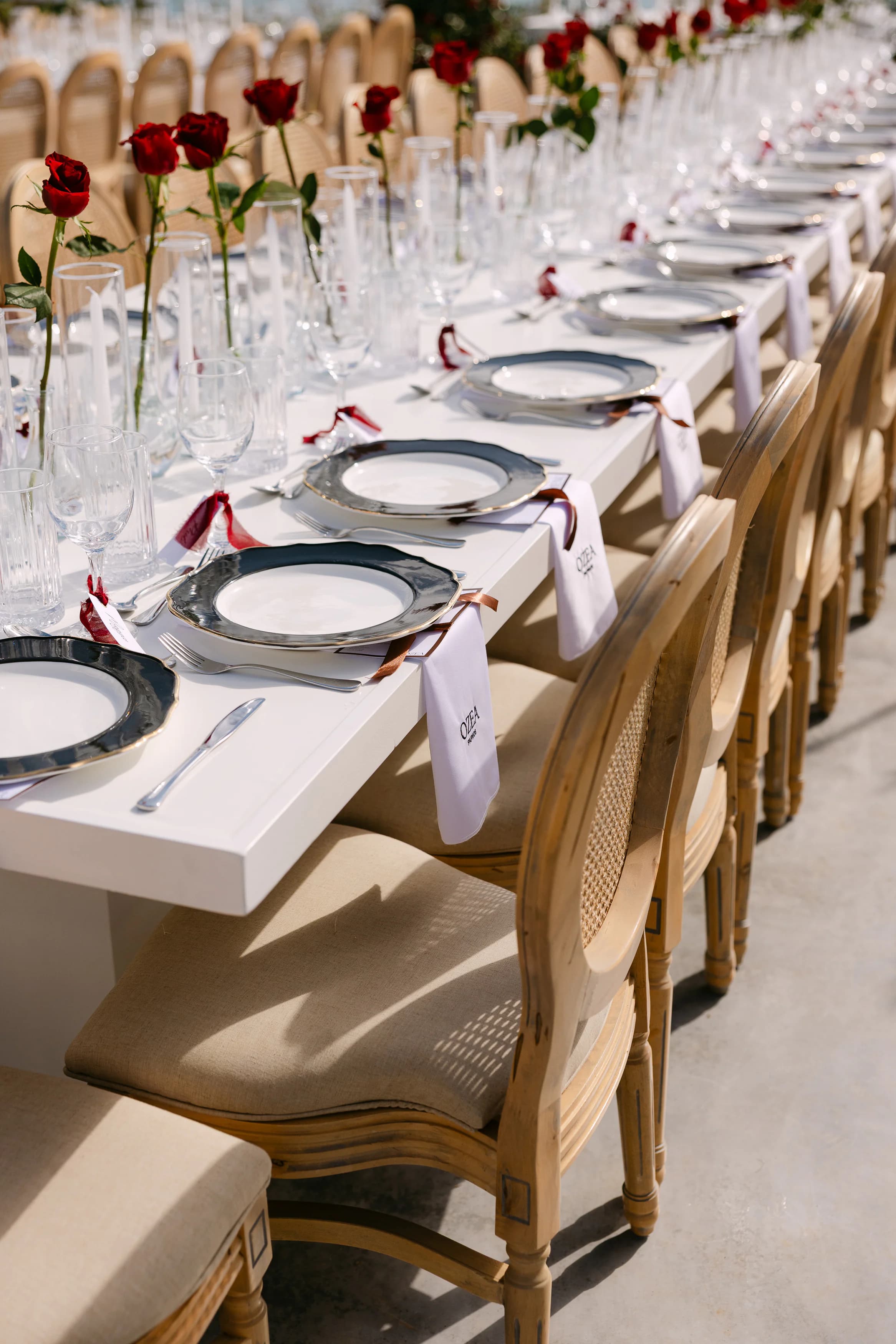
The layer guests spend the most time with — charger plates, ribbon-tied napkins and a name card, repeated the length of the table.
What Cyprus itself does to a design
This is the part that rarely makes it onto a mood board, and it is the part that decides whether a scheme survives contact with the day.
- Wind. Coastal and clifftop sites are the most beautiful spots on the island and the most exposed. Anything tall, light or sail-shaped — draped arches, loose fabric, slim-stemmed arrangements — has to be weighted, anchored or reconsidered. It is not a reason to avoid a clifftop ceremony. It is a reason to design for one deliberately rather than discovering the problem at four o'clock.
- Heat. In July and August the temperature shapes the schedule as much as the design. Florals want shaded staging, sensible variety choices and installation as close to the ceremony hour as the venue will allow, rather than a leisurely morning set-up in full sun. Candles soften. Anything waxy or delicate needs a plan.
- Open flame. Candlelight is central to most evening schemes here, and outdoor sites bring their own constraints — hurricane glass rather than bare pillars in exposed positions, and each venue with its own view on what is permitted where. Worth settling early rather than on the day.
- The light itself. Cyprus gives you a genuinely spectacular golden window before sunset, and it is short. Lighting has to be live and tested before it arrives, not switched on once the sun has gone — otherwise the loveliest half-hour of the evening passes with the festoons still dark. It is one of several reasons the time of year you marry changes more about a design than couples anticipate.
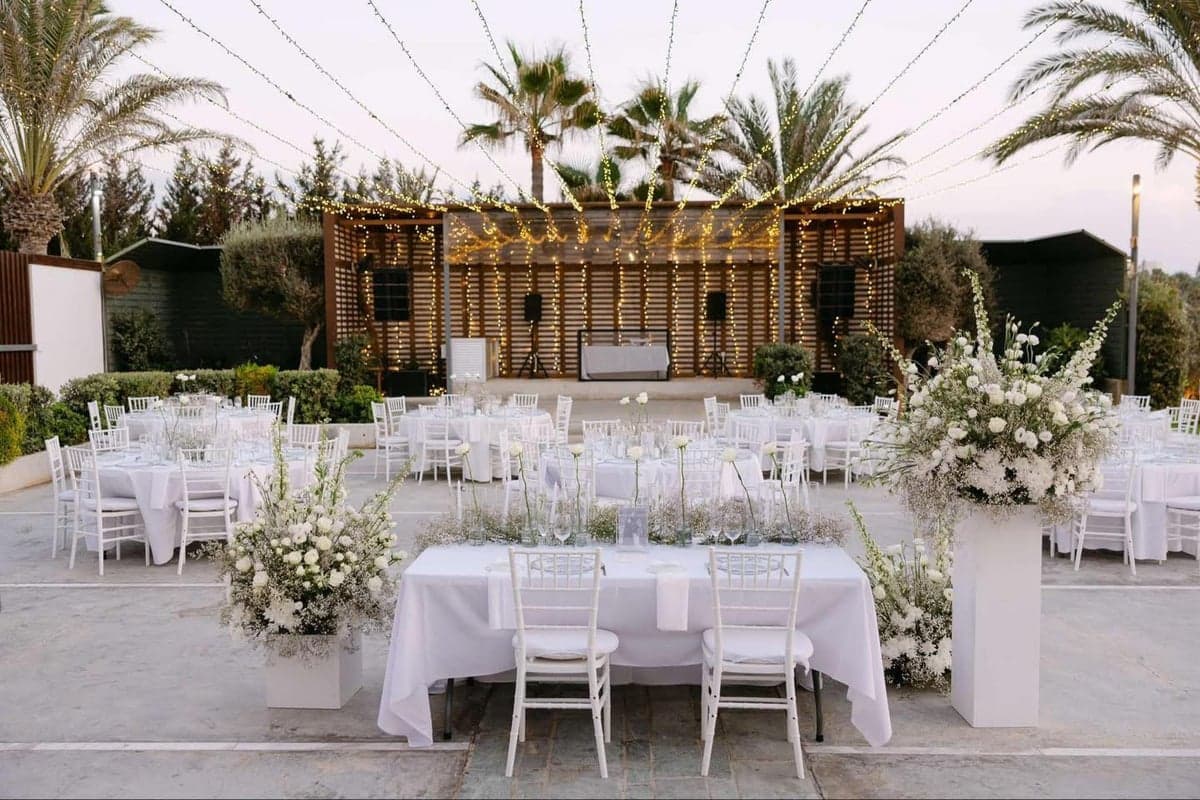
Lighting live before the light goes — a fairy-light canopy at Alassos, carrying the reception through the short golden window and into the evening.
How we build your scheme
We start with a mood board and a conversation about the three things above, not with a catalogue. From there you receive a detailed design proposal covering the ceremony and the reception as one continuous idea rather than two separate jobs.
Then, if you are able to come out, there is the part couples enjoy most. Family-owned since 2016, we pioneered the first dedicated wedding décor showroom in Cyprus, and today we have three of them across Paphos, alongside a hire brochure that runs to somewhere between 385 and 450 pages and grows every season. Seeing a centrepiece at full height, in your own colours, on the actual linen, settles more in an afternoon than weeks of photographs will. If you cannot travel, send us your colour samples — we have a UK address for exactly that — and we will match them properly.
A few practical points worth knowing early:
- A non-refundable €100 "Hold the Day" booking secures your date.
- Guest numbers and final design elements can be confirmed up to four weeks before the wedding, so you are not locked into decisions a year out.
- Prices are locked at the time of booking — no surprise increases between then and the day.
- Couples booking our full planning service receive 10% off all dressing and hire.
Because we are independent rather than tied to any venue's supplier list, the same collection is available to you wherever you are marrying — Paphos, Limassol, Larnaca, Nicosia, Ayia Napa and Protaras. And before the day itself there is a full walkthrough, so the design you signed off is the design that is standing there when the doors open.
If you have a venue, a season and a feeling in mind but no idea yet how to turn it into a scheme, that is a good place to start from — get in touch and we will talk it through properly, with a personal reply and no pressure. If you are still working out the wider shape of the day, our guide to how much a Cyprus wedding costs and our notes on choosing your venue are good companions to this one.
Frequently Asked
How much does wedding decor and styling cost in Cyprus?
There is no fixed price list, because styling scales with the scale of the design — a ceremony arch and simple table florals sit in a very different place to full venue dressing with statement installations and lighting. We build every proposal line by line so you can see exactly what each element costs and adjust before committing, with no hidden supplier mark-ups. Couples booking our full planning service also receive 10% off all dressing and hire.
Can we bring our own wedding decor from the UK?
Small personal pieces travel well and are often the most meaningful part of a scheme — place cards, favours, a guest book, framed photographs. Anything bulky, fragile or heavy is almost always easier and cheaper to hire locally than to fly out, and it arrives without the risk of damage in transit. If you want your colours matched exactly, send us your samples — we have a UK address for precisely that — and we will match them properly.
Do you only style weddings at certain venues in Cyprus?
No. We are completely independent and not tied to any venue's preferred-supplier list, so the full collection is available to you wherever you are marrying. We deliver and style across Paphos, Limassol, Larnaca, Nicosia, Ayia Napa and Protaras, from intimate hilltop chapels to large coastal resorts.
Will wedding flowers survive the heat in Cyprus?
Yes, with the right choices and the right timing. It comes down to selecting varieties that cope well in warmth, conditioning them properly, staging them in shade before the ceremony, and installing as close to the ceremony hour as the venue allows rather than early in full sun. July and August need the most planning, which is simply built into how we schedule the day.
When do we need to confirm our wedding styling?
A non-refundable €100 "Hold the Day" booking secures your date. From there you have real flexibility — guest numbers and final design elements can be confirmed up to four weeks before the wedding, so you are not locked into decisions a year in advance. Prices are locked at the time of booking, so nothing increases between then and the day.